
In the diverse landscape of international schooling, many institutions strive to be "inclusive." However, for some Multilingual Learners (MLLs), the lived experience can still result in a sense of "othering" - a systemic positioning as an outsider within the academic and social fabric.
As I often emphasise in professional development sessions and conversations with peers: Intention does not always equal impact. This is rarely a result of poor intentions; rather, it often stems from how educational systems are designed. For leadership teams, curriculum coordinators, and educators, we must recognise that even the most well-meaning efforts can result in inequitable outcomes if the underlying "road" is not built for the learners it serves. To move toward genuine equity, we can shift our focus from isolated "fixes" to the intentional engineering of a Multilingual Ecosystem.
The Foundational Priority: Learning Through Belonging
Multilingual Pedagogies (Translanguaging)
The RISE Framework: Strategic Pillars for School-Wide Alignment
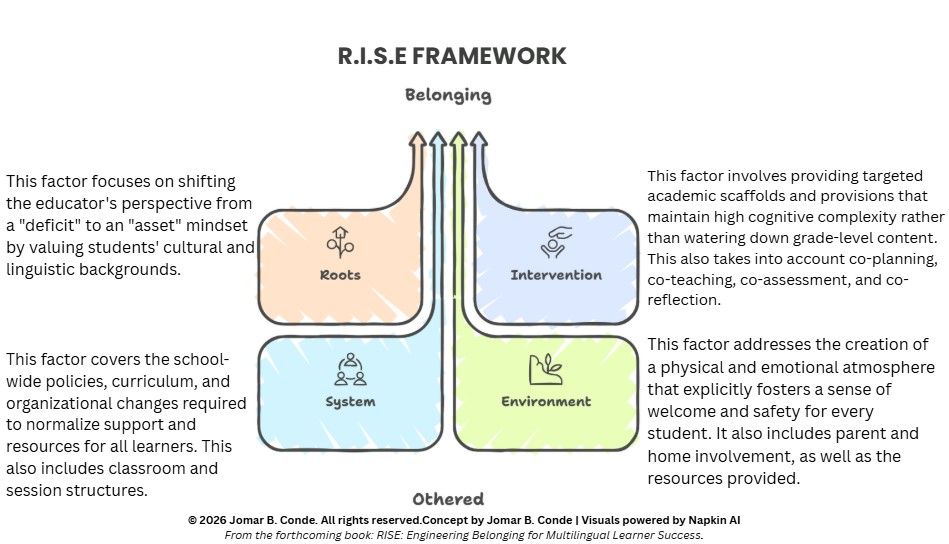
To operationalise this shift, the RISE Framework offers a conceptual engine to move students from the periphery of being "Othered" toward a core of "Belonging." These four pillars serve as a shared roadmap for all stakeholders—from the board room to the classroom—to ensure our impact aligns with our intentions [3]:
- Roots (The Asset-Based Mindset
This pillar focuses on the foundational belief system of the school. Leadership plays a critical role here in fostering an asset-based culture where a student’s home language and cultural background are recognised as intellectual capital [4]. Shifting the discourse requires institutional initiatives that challenge deficit-oriented beliefs, moving educators toward recognising the "depth of knowledge and skills" that students inherently possess. When the school mission values students because of their linguistic identities, it establishes the psychological safety required for deep engagement across all departments. - Intervention (Scaffolding Up)Curriculum leaders and teachers must ensure that "support" does not equate to "watering down" the academic challenge. Effective intervention aligns with the Zone of Proximal Development [5] by maintaining high cognitive complexity while "scaffolding up" [6]. This is a collaborative effort involving translanguaging—encouraging students to use their full linguistic repertoire as a cognitive tool for knowledge construction [7].
- System (Collaborative Infrastructure)Belonging is rarely sustained by individual effort; it requires organisational design. Leadership must prioritise Systems that normalise support, such as co-planning, co-teaching, and integrated scheduling [8]. When language development is treated as a shared institutional responsibility rather than a siloed service, the MLL is more naturally integrated into the school’s academic DNA.
- Environment (The Visible Ecology)This refers to the physical, emotional, and social climate of the entire school. When stakeholders ensure that languages are reflected in the halls and validated in policies, it triggers "identity affirmation" [9]. This creates a "safe to fail" space where academic risk-taking is possible in every facet of school life.
The Belonging-to-Competence Continuum
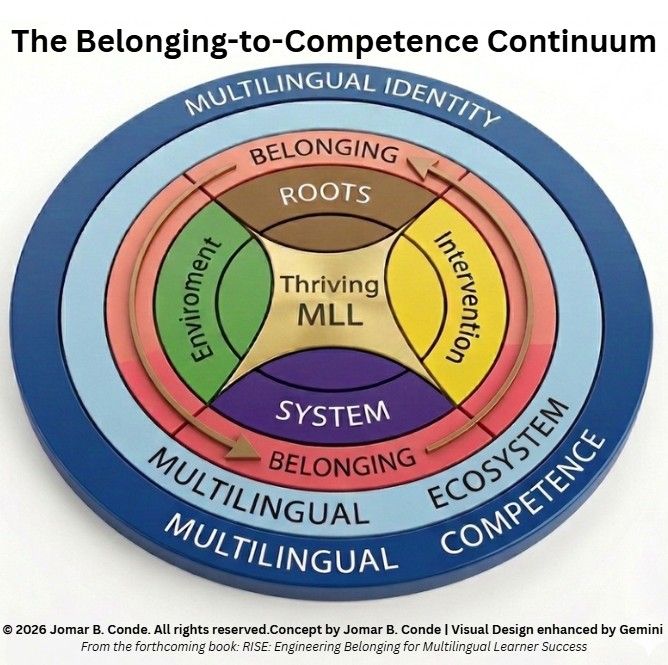
When these four pillars (the engine): Roots, Intervention, System, and Environment, are strategically aligned, they support a functional Belonging-to-Competence Continuum [10].
As illustrated in the model, this is a circular, self-reinforcing process. Intentional Engineering helps create the foundation of Belonging. This sense of safety allows the student to embrace a Multilingual Identity, which can foster the Confidence to engage with complex academic tasks. Over time, this sustained engagement typically leads to increased Competence. The arrow surrounding the framework serves as a reminder: Belonging is a constant and must be consistent.
As illustrated in the model, this is a circular, self-reinforcing process. Intentional Engineering helps create the foundation of Belonging. This sense of safety allows the student to embrace a Multilingual Identity, which can foster the Confidence to engage with complex academic tasks. Over time, this sustained engagement typically leads to increased Competence. The arrow surrounding the framework serves as a reminder: Belonging is a constant and must be consistent.
Conclusion: Redesigning the Road
Multilingual learners are not "broken" versions of monolingual students; they are simply a different shape. If they struggle to navigate certain educational systems, it may not be due to a deficit in the "wheel" (the student), but a need to redesign the "road" (learning experience).
Our task as a community of educators is to ensure that our impact matches our intent. By intentionally engineering our ecosystems through the RISE Framework, we can move closer to ensuring that every student - and every stakeholder - is part of a community where all learners can truly thrive.
Our task as a community of educators is to ensure that our impact matches our intent. By intentionally engineering our ecosystems through the RISE Framework, we can move closer to ensuring that every student - and every stakeholder - is part of a community where all learners can truly thrive.
References & Footnotes
[1] Baumeister, R. F., & Leary, M. R. (1995). The need to belong: Desire for interpersonal attachments as a fundamental human motivation. Psychological Bulletin, 117(3), 497, 504.
[2] Maslow, A. H. (1970). A theory of human motivation. In Motivation and Personality (2nd ed., pp. 43–45). Harper & Row.
[3] Based on the R.I.S.E. Framework first presented by Jomar B. Conde at the 2026 ELLSA Conference, and featured in his forthcoming book, RISE: Engineering Belonging for Multilingual Learner Success.
[4] Griffin, R. A. (2024). Shifting the discourse: How asset-based literacy practices unlock multilingual learners' potential. The Reading Professor, 48(1), 2–3.
[5] Vygotsky, L. S. (1978). Interaction between learning and development. In Mind in Society: The Development of Higher Psychological Processes (pp. 84–91). Harvard University Press.
[6] Walqui, A. (2006). Scaffolding instruction for English language learners: A conceptual framework. International Journal of Bilingual Education and Bilingualism, 9(2), 159-180.
[7] García, O., & Li Wei. (2014). Translanguaging: Language, Bilingualism and Education. Palgrave Macmillan. [As cited and reviewed in Vallejo, C. (2018). Bellaterra Journal of Teaching & Learning Language & Literature, 11(1), pp. 88, 91].
[8] Honigsfeld, A., & Dove, M. G. (2019). Collaborating for English Learners: A Foundational Guide to Integrated Practices (2nd ed.). Corwin. [Reflecting the collaborative framework and administrative roles detailed in Honigsfeld & Dove (2010), pp. 5, 8].
[9] Cummins, J. (2001). Negotiating Identities: Education for Empowerment in a Diverse Society (2nd ed., pp. 74–77). California Association for Bilingual Education. [Reflecting the "Framework for Empowering Minority Students" and the necessity of additive cultural/linguistic identity affirmation].
[10] Based on the Belonging-to-Competence Continuum first presented by Jomar B. Conde at the 2026 ELLSA Conference, and featured in his forthcoming book, RISE: Engineering Belonging for Multilingual Learner Success.
[2] Maslow, A. H. (1970). A theory of human motivation. In Motivation and Personality (2nd ed., pp. 43–45). Harper & Row.
[3] Based on the R.I.S.E. Framework first presented by Jomar B. Conde at the 2026 ELLSA Conference, and featured in his forthcoming book, RISE: Engineering Belonging for Multilingual Learner Success.
[4] Griffin, R. A. (2024). Shifting the discourse: How asset-based literacy practices unlock multilingual learners' potential. The Reading Professor, 48(1), 2–3.
[5] Vygotsky, L. S. (1978). Interaction between learning and development. In Mind in Society: The Development of Higher Psychological Processes (pp. 84–91). Harvard University Press.
[6] Walqui, A. (2006). Scaffolding instruction for English language learners: A conceptual framework. International Journal of Bilingual Education and Bilingualism, 9(2), 159-180.
[7] García, O., & Li Wei. (2014). Translanguaging: Language, Bilingualism and Education. Palgrave Macmillan. [As cited and reviewed in Vallejo, C. (2018). Bellaterra Journal of Teaching & Learning Language & Literature, 11(1), pp. 88, 91].
[8] Honigsfeld, A., & Dove, M. G. (2019). Collaborating for English Learners: A Foundational Guide to Integrated Practices (2nd ed.). Corwin. [Reflecting the collaborative framework and administrative roles detailed in Honigsfeld & Dove (2010), pp. 5, 8].
[9] Cummins, J. (2001). Negotiating Identities: Education for Empowerment in a Diverse Society (2nd ed., pp. 74–77). California Association for Bilingual Education. [Reflecting the "Framework for Empowering Minority Students" and the necessity of additive cultural/linguistic identity affirmation].
[10] Based on the Belonging-to-Competence Continuum first presented by Jomar B. Conde at the 2026 ELLSA Conference, and featured in his forthcoming book, RISE: Engineering Belonging for Multilingual Learner Success.
BLOG AUTHOR
Jomar B. Conde, LPT
Jomar B Conde, LPT, is a dedicated educator with over a decade of experience in fostering inclusive environments. Currently an MLL Specialist at CIA FIRST International School and a SENIA Cambodia Board Member, Jomar has held key leadership roles as a Deputy Campus Director and Program Coordinator. This coming academic year, he looks forward to transitioning into a managerial leadership role at another international school, focusing on EAL provisions.
Driven by equitable education, he developed two distinct frameworks: the RISE Framework for engineering belonging and the 5C Framework for Trust-Based Leadership. A WASC-trained professional and member of the International Business Chamber of Cambodia’s education sub-committee, Jomar enjoys collaborating with the English Language Specialist Network in Asia and sharing insights on curriculum design at educational conferences.
Driven by equitable education, he developed two distinct frameworks: the RISE Framework for engineering belonging and the 5C Framework for Trust-Based Leadership. A WASC-trained professional and member of the International Business Chamber of Cambodia’s education sub-committee, Jomar enjoys collaborating with the English Language Specialist Network in Asia and sharing insights on curriculum design at educational conferences.
Write your awesome label here.