
Mathematics doesn't exist independently of language
While mathematical symbols may be universal, their meanings are not and our understanding is highly individual and personal.
A symbol only becomes meaningful when learners can connect it to concepts, relationships, and ways of thinking. That process happens through language. Whether students are discussing a problem with a partner, interpreting a word problem, explaining their reasoning, or making sense of a new concept, language is constantly mediating mathematical learning.
Even seemingly straightforward mathematical notation is not always universal. Different countries use different conventions, for example, notation such as the decimal point, and algorithms, such as long division. What appears familiar in one context may be interpreted differently in another.
This matters because multilingual learners are often navigating both new mathematical ideas and new linguistic systems simultaneously.
A symbol only becomes meaningful when learners can connect it to concepts, relationships, and ways of thinking. That process happens through language. Whether students are discussing a problem with a partner, interpreting a word problem, explaining their reasoning, or making sense of a new concept, language is constantly mediating mathematical learning.
Even seemingly straightforward mathematical notation is not always universal. Different countries use different conventions, for example, notation such as the decimal point, and algorithms, such as long division. What appears familiar in one context may be interpreted differently in another.
This matters because multilingual learners are often navigating both new mathematical ideas and new linguistic systems simultaneously.
Research into Practice Webinar Series
The language demands of mathematics
One of the challenges in mathematics education is that we often underestimate just how much language is involved.
Of course, there is specialist mathematical vocabulary. But the linguistic demands extend far beyond technical terms. Learners need language to compare, justify, explain, persuade, predict, generalise, and reason.
In many ways, mathematical language functions as a specific register - a particular way of using language to construct meaning within a discipline.
This means that success in mathematics depends not only on understanding mathematical concepts, but also on developing the language needed to express and refine that understanding and the symbols that represent the meaning.
For multilingual learners, these two processes are often happening simultaneously.
Of course, there is specialist mathematical vocabulary. But the linguistic demands extend far beyond technical terms. Learners need language to compare, justify, explain, persuade, predict, generalise, and reason.
In many ways, mathematical language functions as a specific register - a particular way of using language to construct meaning within a discipline.
This means that success in mathematics depends not only on understanding mathematical concepts, but also on developing the language needed to express and refine that understanding and the symbols that represent the meaning.
For multilingual learners, these two processes are often happening simultaneously.
Understanding the relationship between language and content
One framework I shared during the webinar comes from work exploring the relationship between language learning and content learning.
Rather than seeing mathematics and language as separate domains, we can think of classroom tasks along two continua of language demand and of content demand. This can be seen in the slide below.
Rather than seeing mathematics and language as separate domains, we can think of classroom tasks along two continua of language demand and of content demand. This can be seen in the slide below.
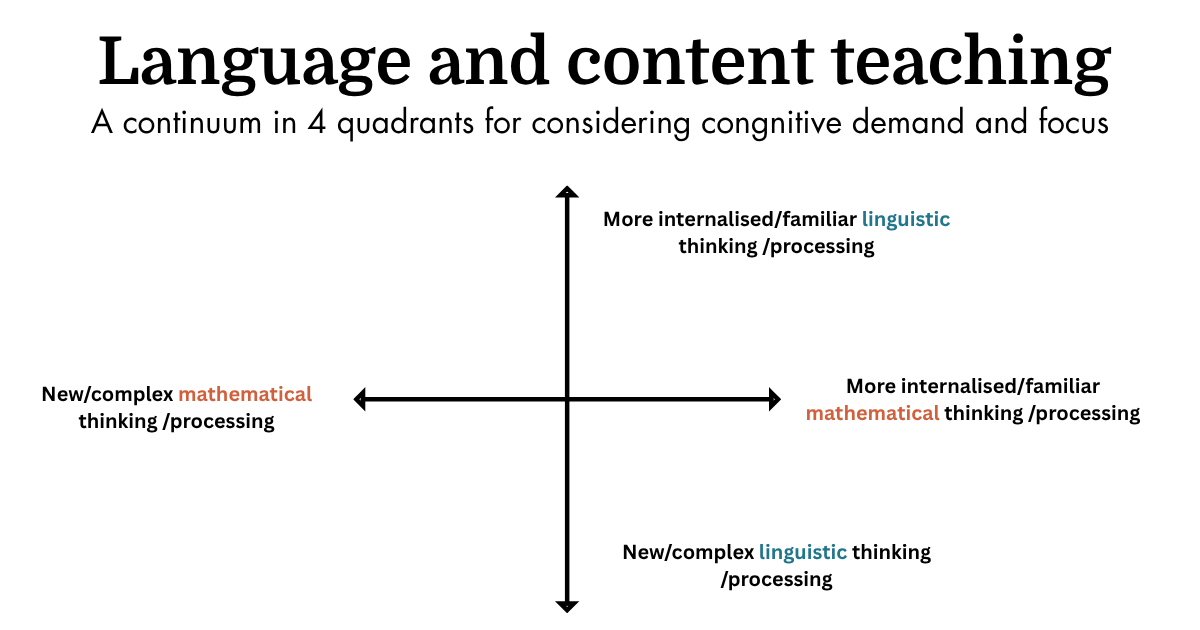
Where you are placing your focus will guide the strategy that you use - pedagogical choice and intended outcome - which quadrant does the task fit within?
At one end are activities with low language and low content demands. At the other are tasks that are both linguistically and conceptually challenging.
At one end are activities with low language and low content demands. At the other are tasks that are both linguistically and conceptually challenging.
The most challenging area for multilingual learners of mathematics sits in the lower-left quadrant, where students are engaging with cognitively demanding mathematics while also developing the academic language needed to discuss, justify, and communicate their thinking. A student may understand a concept but lack the language needed to explain it. Equally, they may be developing academic language while still grappling with new mathematical ideas.
Recognising where tasks sit within this quartet helps teachers make more informed decisions about the kinds of support learners might need.
The goal is not to reduce challenge. Rather, it is to ensure that language demands do not unnecessarily obscure the development of mathematical understanding.
Mathematics and Multilingualism
Why home language matters
Too often, discussions about multilingual learners focus on what students cannot yet do in the language of instruction. More productive questions are: what knowledge and understanding do they already bring to their learning and how can their home language be harnessed as a resource for their learning?
Research consistently shows that conceptual understanding developed in one language can support learning in another. This applies in mathematics just as much as it does in literacy.
A learner who understands fractions, proportional reasoning, or algebraic thinking in their home language does not need to relearn those concepts when they enter an English-medium classroom. The challenge is creating opportunities for students to demonstrate and build on that existing knowledge.
This is one reason why translanguaging can be such a powerful tool in mathematics education. Allowing learners to draw on their full linguistic repertoire can help them process ideas, develop understanding, and engage in mathematical reasoning at an appropriate level, without limited English proficiency impacting their learning .
Research consistently shows that conceptual understanding developed in one language can support learning in another. This applies in mathematics just as much as it does in literacy.
A learner who understands fractions, proportional reasoning, or algebraic thinking in their home language does not need to relearn those concepts when they enter an English-medium classroom. The challenge is creating opportunities for students to demonstrate and build on that existing knowledge.
This is one reason why translanguaging can be such a powerful tool in mathematics education. Allowing learners to draw on their full linguistic repertoire can help them process ideas, develop understanding, and engage in mathematical reasoning at an appropriate level, without limited English proficiency impacting their learning .
What does the research tell us?
During the webinar, I shared findings from Erath's (2021) meta-analysis of research into multilingual learners and mathematics education.
Across a wide range of studies, six design principles emerged as particularly important.
For language learning to be a catalyst for mathematics learning, materials and instruction should do the following:
What I find particularly interesting about these principles is that they are not only strategies for multilingual learners, they are components of high-quality mathematics teaching.
The difference is that multilingual learners make their importance more visible.
Across a wide range of studies, six design principles emerged as particularly important.
For language learning to be a catalyst for mathematics learning, materials and instruction should do the following:
- Engage students in rich discourse practices,
- Establish various mathematics language routines,
- Connect language varieties and multimodal representations,
- Include students' multilingual resources,
- Use macro-scaffolding to sequence and combine language and mathematics learning opportunities,
- Compare language pieces (form, function, etc.) to raise students' language awareness.
What I find particularly interesting about these principles is that they are not only strategies for multilingual learners, they are components of high-quality mathematics teaching.
The difference is that multilingual learners make their importance more visible.
Full list of academic references
Moving beyond monolingual assumptions
Perhaps the most important reflection from the webinar is that many of our educational systems still operate from monolingual assumptions, despite the fact that multilingualism is the global norm.
When we assume that mathematical understanding can only be demonstrated through one language, we risk assessing language proficiency rather than mathematical thinking. When we separate second language proficiency from conceptual understanding, we enable the levels of mathematical thinking to become more visible.
Supporting multilingual learners in mathematics is therefore not about simplifying mathematics. It is about designing learning environments that recognise the relationship between harnessing linguistic repertoires and developing mathematical thinking.
By recognising learners' linguistic resources, making mathematical language visible, and creating opportunities for students to think across languages, we can create mathematics classrooms that are both more equitable, inclusive and more mathematically rich for everyone.
For more information, look out for our seminar sessions at BCME 10, where we will be presenting about two multilingual maths projects, one for the primary phase and one for the secondary phase.
Also look out for our free Multilingual Maths Learner Toolkit, available from the BBO Maths Hub website in late September 2026.
When we assume that mathematical understanding can only be demonstrated through one language, we risk assessing language proficiency rather than mathematical thinking. When we separate second language proficiency from conceptual understanding, we enable the levels of mathematical thinking to become more visible.
Supporting multilingual learners in mathematics is therefore not about simplifying mathematics. It is about designing learning environments that recognise the relationship between harnessing linguistic repertoires and developing mathematical thinking.
By recognising learners' linguistic resources, making mathematical language visible, and creating opportunities for students to think across languages, we can create mathematics classrooms that are both more equitable, inclusive and more mathematically rich for everyone.
For more information, look out for our seminar sessions at BCME 10, where we will be presenting about two multilingual maths projects, one for the primary phase and one for the secondary phase.
Also look out for our free Multilingual Maths Learner Toolkit, available from the BBO Maths Hub website in late September 2026.