
During a thought-provoking conversation with a colleague, Stuart MacFarlane MacAlpine, I was introduced to Triple A+ Learning, a framework he had recently developed at United World College South East Asia (UWC SEA) to enhance learning through a thoughtful sequence of awareness, abstraction, application, and deliberate practice.
Since receiving a copy of Triple A+ (2017), this approach has consistently informed my work, whether planning lessons for diverse learners, designing projects to support integration and education for newcomers, or currently, creating online learning experiences for educators within the OCME community.
Since receiving a copy of Triple A+ (2017), this approach has consistently informed my work, whether planning lessons for diverse learners, designing projects to support integration and education for newcomers, or currently, creating online learning experiences for educators within the OCME community.
With the recent publication of Stuart’s new book, AAA+ The Hesscairn Guide to Teaching for Understanding: How to Teach Big Ideas, I find it timely to reflect on how Triple A+ has shaped my approach to planning learning experiences, and how its latest edition can continue to inform my practice.
Awareness
Triple A+ Learning originated through collaboration at UWC SEA, aiming to tackle the core question: How does learning work? The framework identifies patterns that help both educators and students make sense of learning processes.
Though initially designed for international and refugee education, its application is now widespread. At its core, Triple A+ acknowledges that learners make sense of the world by recognising patterns, assigning conceptual labels, and thinking critically in real-world contexts (2017:4). This empowers them to construct meaningful and transferable understandings.
At OCME, we believe Triple A+ aligns with the experience we wish to craft for our course participants, encouraging deep understanding of core concepts and practical experimentation until confidence is built and mastery is achieved. This framework guides us in designing learning experiences that move seamlessly from theory to practice, always attuned to the learner’s stage of development.
My first encounter with Triple A+ was during an Amala Education hackathon. Our diverse team of students, educators, and professionals, used the framework to design an “English for Changemakers” curriculum over several intense but incredibly rewarding days. Triple A+ anchored our process, focusing our efforts at every stage of design, while also being reflected in the very learning experiences we created.
Research into Practice Webinar Series
Abstraction
After the hackathon, I began integrating Triple A+ into my everyday teaching, complementing it with insights from Zusho and Bondie (2018) on differentiation strategies. Their clarity planner, which emphasises backward planning and student-centered learning, paired perfectly with Triple A+.
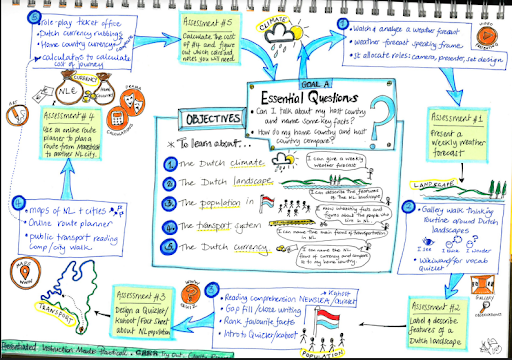
As a visual learner, I developed a planning template that quickly became an essential tool in my kit. One memorable example: collaborating with Year 4 EAL students to co-create a unit planner for a project about our host country. Language functions remained a priority, but students drove the content, tailoring it to their interests and questions about their new environment. This approach fostered genuine motivation and student agency, making our unit plan a true blueprint for our learning journey.
Application
Incorporating Triple A+ (alongside Zusho and Bondie’s work) transformed my planning by making learning experiences clearer, more accessible, and highly relevant. I have since used this approach in a wide range of settings:
- Policy reviews and pilot projects as an educator
- Project planning for EU funding applications in Sweden’s integration and education sector
- Identity projects as a visiting artist in a refugee camp
- Personal communication as a PhD researcher
- Course design at OCME, where it underpins our philosophy
Deliberate practice
After nearly a decade with Triple A+ as a constant in my planning, it now informs my work almost intuitively. Yet, I’m eager to explore Stuart’s latest iteration, stretching my own awareness, abstraction, application, and deliberate practice even further.
If you’re curious about Triple A+, join us this autumn for a conversation with Stuart as part of our OCME webinar series, and keep an eye out for a special book discount if you’d like to add Triple A+ to your own planning toolkit.
References
- Amala Education. Retrieved July 17, 2026, from https://www.amalaeducation.org/
- Bondie, R., & Zusho, A. (2018). Differentiated Instruction Made Practical: Engaging the Extremes Through Classroom Routines. Routledge.
- MacAlpine, S. M. (2026). AAA+ the Hesscairn Guide to Teaching for Understanding: How to Teach Big Ideas. Ingrove Press.
- United World College South East Asia. (2017). Triple A+ Learning: Planning for Learning cycle. UWC SEA.