
Amara is eleven years old. She speaks Khmer at home, French with her grandmother, and English at school. In her Grade 5 Science class, she is working on a unit about ecosystems — a concept she understands deeply in Khmer from her grandmother's stories about the Tonle Sap lake. But the unit is taught entirely in English, and the assessments are in English, and the graphic organizers are in English. Amara knows what an ecosystem is. But the system does not know that she knows.
The Water Level Principle
Multilingual Pedagogies (Translanguaging)
The Linguistic Desert
Dr. Virginia Rojas (2026), writing in TIE, names the institutional condition that produces the low water level: the monolingual habitus — what Gogolin (2013) first defined as the deeply ingrained institutional assumption that one language is the natural default of schooling. When schools operate under the monolingual habitus, language support is reactive, specialist roles are marginal, and co-teaching is an aspiration rather than a structural commitment. The result is what might be described as a linguistic desert at the classroom level: a school environment in which the linguistic conditions for deep learning are absent, not because teachers do not care, but because the systems were not designed to produce them.
The linguistic desert shows up in master schedules that do not protect co-planning time. It shows up in assessment systems that measure English proficiency rather than content mastery. It shows up in curriculum maps that treat language as a separate subject rather than the medium of every subject. And it shows up in the daily experience of students like Amara — who bring rich linguistic repertoires to school and find that the school has no structural way to recognize, leverage, or build on what they already know.
The linguistic desert shows up in master schedules that do not protect co-planning time. It shows up in assessment systems that measure English proficiency rather than content mastery. It shows up in curriculum maps that treat language as a separate subject rather than the medium of every subject. And it shows up in the daily experience of students like Amara — who bring rich linguistic repertoires to school and find that the school has no structural way to recognize, leverage, or build on what they already know.
What Raises the Water
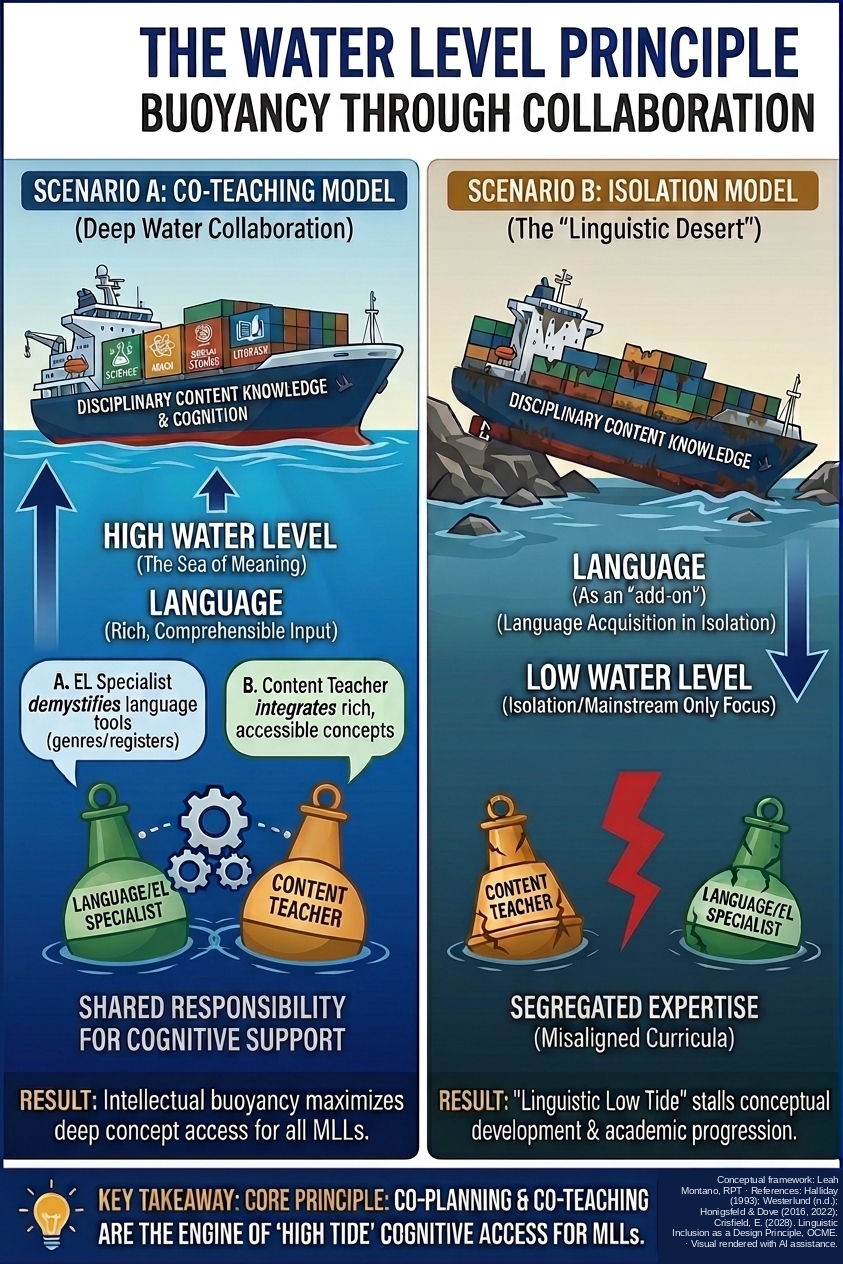
The Water Level Principle argues that co-teaching — genuine co-teaching, not the MLL specialist circulating as a classroom aide — is the primary mechanism for raising the water level. When an EL specialist and a content teacher plan a unit together, they bring two forms of expertise into contact: the content teacher's disciplinary knowledge and the language specialist's understanding of how academic language works at the word, sentence, and discourse level (Westerlund, n.d.; Honigsfeld & Dove, 2018, 2022). Neither alone is sufficient. Together, they raise the water.
Crisfield (2026) articulates the design principle precisely: linguistic inclusion is not an initiative but the architecture. It is not something a school does in addition to its core work. It is the structural condition that makes the core work accessible to all learners.
The Forbes and Morea (2024) language ecology model demonstrates that schools treating language as a unified ecological system produce more coherent outcomes for multilingual learners. The water level rises when language is everyone's responsibility, embedded in every curriculum map, every co-planning session, and every assessment design.
Crisfield (2026) articulates the design principle precisely: linguistic inclusion is not an initiative but the architecture. It is not something a school does in addition to its core work. It is the structural condition that makes the core work accessible to all learners.
The Forbes and Morea (2024) language ecology model demonstrates that schools treating language as a unified ecological system produce more coherent outcomes for multilingual learners. The water level rises when language is everyone's responsibility, embedded in every curriculum map, every co-planning session, and every assessment design.
Three Options — and What the Water Reveals
Rojas (2026) identifies three options for international schools confronting the monolingual habitus: maintain English monolingualism as the default, make cosmetic multilingual gestures while the habitus persists, or deliberately dismantle the habitus and place a multilingual ecology at the center of institutional design. The Water Level Principle is a diagnostic for that third option.Look at the master schedule. Does it protect co-planning time between EL specialists and content teachers?
Look at the curriculum map. Does it include language objectives alongside content objectives? Look at the assessment system. Does it separate content mastery from English language proficiency? Look at the hiring criteria. Does the school treat native English speaker status as a credential? The answers to these questions tell you which option the school has actually chosen — regardless of what the mission statement says.
"Systems reveal which option a school has actually chosen — regardless of what their mission statement says."
When the water is high, Amara's ship floats. When the water drops, she runs aground — not because she lacks the capacity for rigorous learning, but because the school's systems were designed for a different student. The Water Level Principle asks one question of every school that claims to serve multilingual learners: what are you doing, structurally, to raise the water?
Look at the curriculum map. Does it include language objectives alongside content objectives? Look at the assessment system. Does it separate content mastery from English language proficiency? Look at the hiring criteria. Does the school treat native English speaker status as a credential? The answers to these questions tell you which option the school has actually chosen — regardless of what the mission statement says.
"Systems reveal which option a school has actually chosen — regardless of what their mission statement says."
When the water is high, Amara's ship floats. When the water drops, she runs aground — not because she lacks the capacity for rigorous learning, but because the school's systems were designed for a different student. The Water Level Principle asks one question of every school that claims to serve multilingual learners: what are you doing, structurally, to raise the water?
About the Framework
AI Use Disclosure
References & Footnotes
- Anthropic. (2026). Claude (claude-sonnet-4-6) [Large language model]. https://claude.ai
- Crisfield, E. (2026). Linguistic inclusion as a design principle. Oxford Collaborative for Multilingualism in Education. https://ocme.uk/blog/linguistic-inclusion-as-a-design-principle
- Forbes, K., & Morea, N. (2024). Mapping school-level language policies across multilingual secondary schools in England. British Educational Research Journal, 50, 1189–1207.
- Gogolin, I. (2013). The "monolingual habitus" as the common feature in teaching in the language of the majority in different countries. Per Linguam, 12(2), 38–49.
- Halliday, M.A.K. (1993). Towards a language-based theory of learning. Linguistics and Education, 5(2), 93–116.
- Honigsfeld, A., & Dove, M.G. (2018). Co-Teaching for English Learners. Corwin.
- Honigsfeld, A., & Dove, M.G. (2022). Co-Planning: 5 Essential Practices. Corwin.
- Montano, L. (2026). Engineering the road: Systems as the architecture of belonging. In J. Conde (Ed.), R.I.S.E.: Engineering Belonging for Multilingual Learner Success [Forthcoming].
- Rojas, V.P. (2026). Dismantling the monolingual paradox of multilingual schools. The International Educator. https://www.tieonline.com
- Westerlund, R. (n.d.). Language and content are interdependent [LinkedIn post]. LinkedIn. https://www.linkedin.com/posts/drruslana_disciplinaryliteracy-wida-multilinguallearners-share-7470945100005584896-nWY8/
BLOG AUTHOR
Leah Montano, RPT
Leah Montano, RPT, is a multilingual learning specialist at CIA FIRST International School in Phnom Penh, Cambodia, with eighteen years of experience supporting multilingual learners across South Korea, Vietnam, and Cambodia. She is a chapter author for the forthcoming R.I.S.E. Framework book edited by Jomar Conde. She is a member of TESOL International Association, ASCD, and AIELOC.
Write your awesome label here.